Queer Places:
Lendinara Cemetery, Rettilineo Cà Morosini, 45026 Lendinara RO
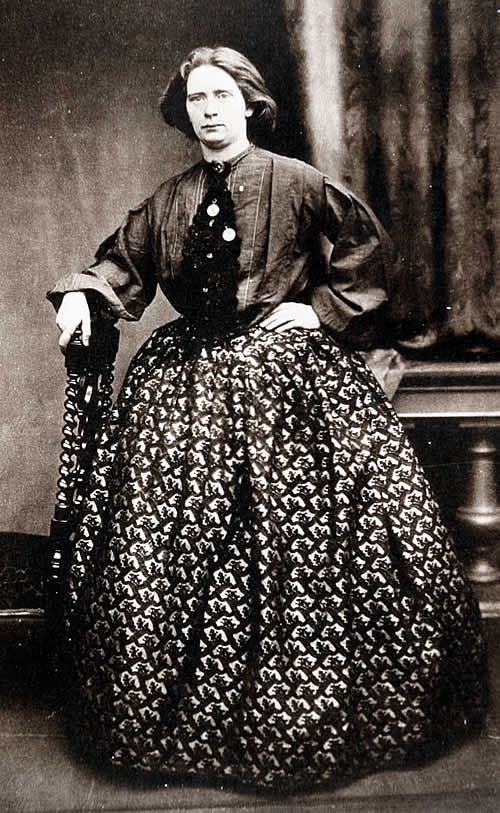 Jessie White Mario (May 9, 1832 - March 5, 1906) was a prominent British-born writer, journalist, and social reformer who became a naturalized Italian citizen. Often referred
to by her Italian nickname, "Miss Uragano" (Hurricane Jessie)—a title given to her by Giuseppe Mazzini—she was a central figure in the Italian Risorgimento (the movement for
Italian unification) and a pioneering social investigator.
Jessie White Mario (May 9, 1832 - March 5, 1906) was a prominent British-born writer, journalist, and social reformer who became a naturalized Italian citizen. Often referred
to by her Italian nickname, "Miss Uragano" (Hurricane Jessie)—a title given to her by Giuseppe Mazzini—she was a central figure in the Italian Risorgimento (the movement for
Italian unification) and a pioneering social investigator.
Born Jessie Jane Meriton White on May 9, 1832, in Gosport, Hampshire, England, she was the daughter of Thomas White, a wealthy shipbuilder, and his wife, Jane Teage
Meriton. Following a childhood influenced by progressive educators and liberal thinkers like John Stuart Mill, she pursued studies in philosophy at the Sorbonne in Paris
between 1852 and 1854.
Her commitment to the Italian cause began in the mid-1850s. After meeting Giuseppe Garibaldi in Nice, she dedicated herself to Italian independence, acting as a
fundraiser, propagandist, and correspondent.
Following her involvement with Garibaldi, she sought to train as a doctor to treat soldiers, but her applications to medical schools in England were rejected due to her
gender.
She served as a nurse and ambulance driver for Garibaldi’s forces in several campaigns, including the Expedition of the Thousand, the battles in Aspromonte and Mentana,
and in the Vosges (1870).
In 1857, she married the Italian writer and patriot Alberto Mario, whom she met while both were imprisoned for their political activities.
Jessie White Mario was a prolific writer, contributing to prestigious international publications such as the American periodical 'The Nation' (from 1866 to 1906),
'The Morning Star', and various Italian journals like 'Nuova Antologia'.
She is recognized as a pioneer of social investigative journalism. Her work often focused on the plight of the marginalized, including:
''Conditions in Naples:'' Her exposé 'La miseria in Napoli' (1877) is considered one of the first major pieces of investigative journalism in Italy, detailing the lives
of people living in subterranean grottos.
''Sicilian Mines:'' In 1894, she published 'Le miniere di zolfo in Sicilia' (The Sulphur Mines in Sicily), which investigated the exploitation of workers, including
children, in the island's mines.
Beyond her journalism, she became the primary biographer for the key figures of the 'Risorgimento', writing definitive accounts of:
''Giuseppe Garibaldi'' ('Vita di Giuseppe Garibaldi', 1882)
''Giuseppe Mazzini'' ('Mazzini nella sua vita e nel suo apostolato', 1890)
Other patriots such as Agostino Bertani and Carlo Cattaneo.
Jessie White Mario spent her final years in Florence, where she died on March 5, 1906. She is buried alongside her husband in Lendinara, Italy. She is remembered today
for her courage, her intellectual rigor, and her tireless advocacy for social justice during a transformative period in European history.
References:
- https://en.wikipedia.org/wiki/Jessie_White_Mario
- https://www.browningscorrespondence.com/biographical-sketches/?nameId=1129
- https://www.alcatraz.it/il-viale-delle-giuste/biografia-jessie-white-mario/
- https://www.150anni.it/webi/stampa.php?wid=1910&stampa=1
- https://www.castelvecchieditore.com/prodotto/vita-di-giuseppe-mazzini/
Support this project
This website is a passion project researched, developed, and funded entirely by me. If you find the content valuable and would like to help support the ongoing research and hosting costs, any contribution is deeply appreciated.
Thank you for keeping this independent resource alive!
My books on Amazon: Elisa Rolle's books
BACK TO HOME PAGE